

Saturday, February 04, 2006
Friday, February 03, 2006
Khalid Ibn Al-Walid Mosque (Homs - حمص)
The Khaled Ibn Al-Walid Mosque takes its name from the Arab Muslim leader Khaled Bin Al-Walid who lived in Homs for the last seven years of his life. This building is distinguished by its metal dome which reflects sunshine. It is also famous for its two high minarets and narrow galleries built with black and white stones in a horizontal manner. 


Nouria water wheel (Hama - حماه)
Hama is famous for its water wheel, Nouria, which is the World's largest as lies on the Orontes River.
Nouria water wheel:
Nouria water wheel at night:

Nouria water wheel:

Nouria water wheel at night:


Hama - حماه
The Hama province, on the Orontes River.Hama is the centre of an agricultural area that produces cereals, grain, fruit, vegetables; as well as cotton, wool and silk. Industries include cotton textiles, tanning and production of cement.Hama is one of the most beautiful cities in Syria, and famous for its water wheels, nouria. The nourias no longer serve their original purpose of providing water for drinking and irrigation. But they are well kept by the local authorities, and a great tourist attraction. The nourias measure between 10 and 22 metre in diametre, are built from wood starting in the 14th century. 

Tartus - طرطوس
The Tartus province, on the coast facing the Mediterranean Sea, and opposite Arwad Island about 3 km offshore.Tartus thrives from being a fishing port, and the largest city and centre of a rich agricultural region. Today, Tartus is the second largest port of Syria next to Lattakia. The city has also seen substantial growth from benefits of its proximity to coastal Lebanon, both trough trade and also the heavy military presence in Lebanon.Among the most important sights of Tartus are the Cathedral of Our Lade of Tortosa from the 13th century, and the Castle of the Templars of late 12th to 13th century. 

Homs - حمص
Homs has a strategic position, facing the only natural gateway between the Mediterranean coast and the densely populated interior (with access to Aleppo to the north and Damascus to the south).The main product of Homs is silk. Other important products include jewelry, belts and cloaks. Industries include an oil refinery, production of fertilizers, vegetable oil, refined sugar. The surrounding area produces wheat, corn, millet, cotton, fruits and vegetables, for which Homs is the centre of trade.Homs has a university that opened in 1979, a very important military academy, as well as an agricultural research station.
Homs City:

Homs City:


Public park in Homs (these sceneries are common in Syria's public parks and city centres):
Krak De Chevalier (Homs - حمص)
(French-Arabic: Castle of the Knights), greatest fortress built in Syria, one of the most notable surviving examples of medieval military architecture. Built at Qal'at al-Hisn, Syria, near the northern border of present-day Lebanon, Krak occupied the site of an earlier Muslim stronghold. 

Sunday, December 18, 2005
Lattakia - الاذقيه
Lattakia (Al ladhiqiyah) Is the main sea-port of Syria on the Mediterranean. It is situated on the low-lying Ra's Ziyarah promontory that projects into the Mediterranean Sea. It was known to the Phoenicians as Ramitha and to the Greeks as Leuke Akte. Its present name is a corruption of Laodicea, for the mother of Seleucus II (3rd century BC).Lattakia lies 186 km southwest of Aleppo, 186 km northwest of Homs and 348 km northwest of Damascus.
Lattakia has retained its importance since ancient times. As Lattakia is the sea-gate to Syria, It is well-provided with accommodation, and is well-placed as a base from which to explore the coastal regions of the country. There are beaches, mountains, archaeological sites and many relics of the Crusaders, all within a few hours from each other.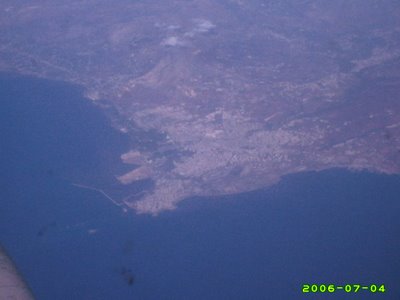
The Lattakia coastline with mountains in the background: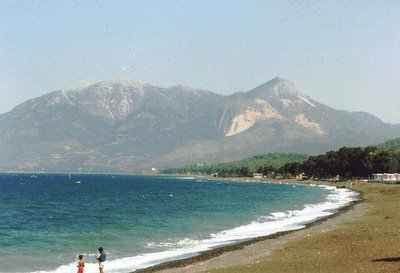
Lattakia has retained its importance since ancient times. As Lattakia is the sea-gate to Syria, It is well-provided with accommodation, and is well-placed as a base from which to explore the coastal regions of the country. There are beaches, mountains, archaeological sites and many relics of the Crusaders, all within a few hours from each other.

The Lattakia coastline with mountains in the background:

Aleppo Ommayad Mosque
The Great Mosque of Aleppo is similar to the larger Ommayad Mosque in Damascus. It is also in the city centre and you can see the Aleppo Citadel in the background: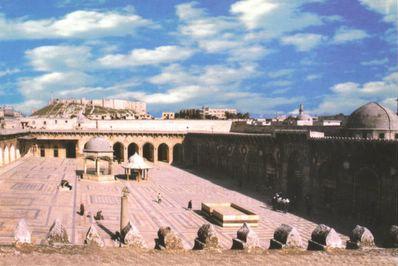
The Great Mosque of Aleppo was built on the same lines as the Damascus Mosque which was built during the caliphate of Suleiman Ibn Abdelamalek. It was demolished several times, the first being when the emperor Nicephorus raided and destroyed the city of Aleppo, and the last one at the hands of Tamerlane. It was rebuilt during the Mameluke Era and the oldest part of it is its magnificent minaret, a square-shaped edifice built in 1090 A.D. It is also famous for its wooden pulpit made out of ebony and inlaid with ivory, fashioned during the reign of Sultan El Nasser Mohammed Ibn Qalawoun in the 8th A.H./14th A.D. century.

The Great Mosque of Aleppo was built on the same lines as the Damascus Mosque which was built during the caliphate of Suleiman Ibn Abdelamalek. It was demolished several times, the first being when the emperor Nicephorus raided and destroyed the city of Aleppo, and the last one at the hands of Tamerlane. It was rebuilt during the Mameluke Era and the oldest part of it is its magnificent minaret, a square-shaped edifice built in 1090 A.D. It is also famous for its wooden pulpit made out of ebony and inlaid with ivory, fashioned during the reign of Sultan El Nasser Mohammed Ibn Qalawoun in the 8th A.H./14th A.D. century.
Olive Trees
Olive trees are very common in Syria. They make up one of the main agricultural exports from Syria. Farm houses in Syria have olive trees everywhere in their gardens
This is a picture of olive tree plantations in Tartus, a city located on the Mediterranean coastline of Syria just south of Lattakia: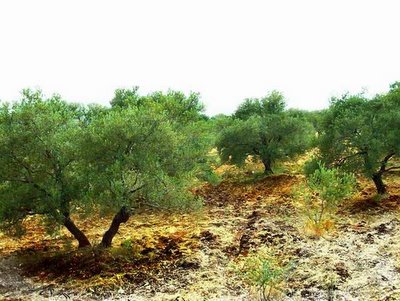
This is a picture of olive tree plantations in Tartus, a city located on the Mediterranean coastline of Syria just south of Lattakia:

Subscribe to:
Posts (Atom)
 DreamHost promos