
Thursday, June 08, 2006
Deir az-Zawr - دير الزور
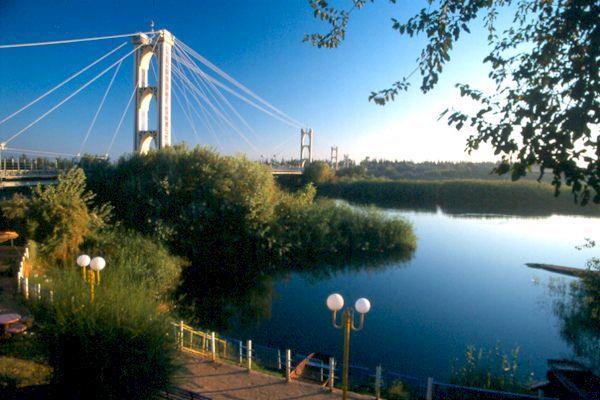
Deir az-Zawr is a city in North Eastern Syria on the Euphrates River and capital of Deir az-Zawr governorate. It has a population of 133,000 (1994 estimate). It is a prosperous farming area, with cattle breeding, cereals and cotton crops. Since the discovery of light crude oil in the Syrian desert it has become a centre for the country's oil extraction industry.
Dayr az Zawr situated 85 km to the north-west of the archeological remains of Dura-Europos and 120km North West of the remains of the ancient city of Mari. During Roman times it was an important trading post between the Roman Empire and India. Conquered by Zenobia, it became part of the kingdom of Palmyra.
The modern town was built by the Ottoman Empire in 1867.
It has a regional level museum, Arabian Cultural Center and has a some academic faculties as Agriculture, Science, Arts & Human Sciences, Education, Law and Medicine with many vocational high schools and professional institutes. Local daily newspaper Al Furat published there.
Dayr az Zawr situated 85 km to the north-west of the archeological remains of Dura-Europos and 120km North West of the remains of the ancient city of Mari. During Roman times it was an important trading post between the Roman Empire and India. Conquered by Zenobia, it became part of the kingdom of Palmyra.
The modern town was built by the Ottoman Empire in 1867.
It has a regional level museum, Arabian Cultural Center and has a some academic faculties as Agriculture, Science, Arts & Human Sciences, Education, Law and Medicine with many vocational high schools and professional institutes. Local daily newspaper Al Furat published there.

Tuesday, April 18, 2006
Roman Theatre (Bosra - بصرى)
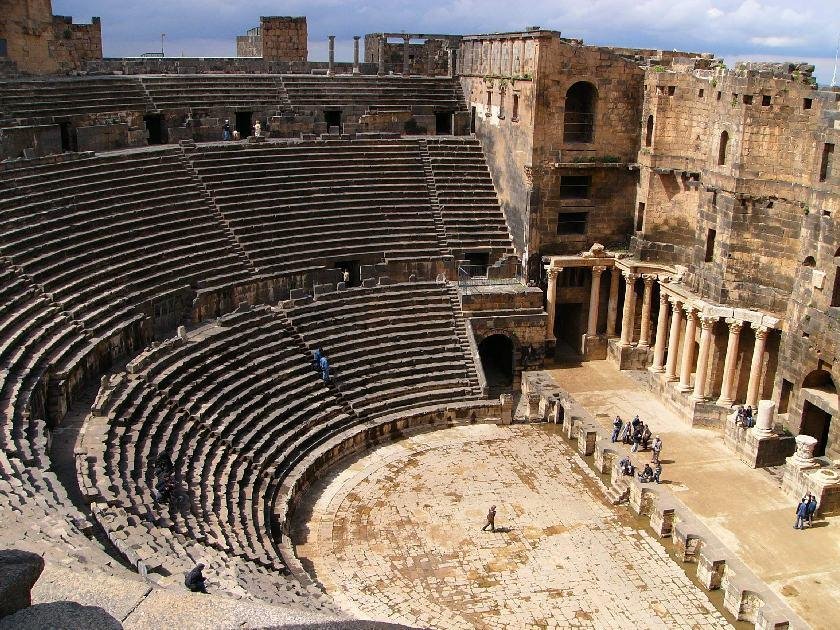
Bosra boasts one of the best preserved Roman amphitheatres of the Roman world where performances are still held today, including the internationally acclaimed annual arts festival.
Bosra - بصرى
Situated 140 Km south of Damascus in the Horan plain, is the ancient city of Bosra. This city of Bosra, was first mentioned in the Hieroglyphics of Thutmos III and Akhnatoun in the 14th century BC, and 1000 years later was the capital of the Nabatean kingdom under the name of Bousra. Later in the Hellenistic era it bore the name of Boustra.
Bosra, grew the most under the Romans, who paid great attention to it and was named Niatrojana Bostra as the capital of the state of Djezire under the king Trojan. It was later attacked by Zenobia in 268 AD, however she only occupied it for a while and did not leave her mark. In the Byzantine period Bosra became the seat of an archbishop who was in charge of 33 bishops in the area.
In 632 AD, Bosra was the first Byzantine city to fall to the Arab Muslims, and it flourished greatly as a point on both the trade route and the pilgrimage route between Damascus and Mecca. The crusaders failed to take it over but it was their threat that pushed the Ayyubids into converting the theater into a fortress. Bosra survived the Mongol invasion, and later under the Mamelukes the main pilgrimage routes moved westwards and this left Bosra quite abandoned, until the Druze moved here from Lebanon in the 18th and19th centuries.
Bosra is most famous for its magnificent Roman amphitheater, which was later converted into a fortress by the Ayyubids. The original theater, which has been miraculously preserved, seats 15 000 and its stage is 45 meters in length and 8 meters in depth. It has been designed so that all the audience can hear the actors without the use of any special equipment. The theater has been renovated and restored, especially a lot of the columns. There is a large area in front of the stage that might've been used for circuses or gladiatorial matches.
Most of the Ayyubid fortress that envelops the theater remains. It was built by the Ayyubids except for a few towers built by the Seljuks. One of the Ayyubid towers on the outer arc has now been turned into a folkloric museum.
The rest of Bosra is a city resembling the nearby town of Shahba, and like most other Roman cities is built in a grid like pattern. Other vestiges include a monumental arch, the western gate called Bab Al Hawa, the Roman baths, the Mosque of Omar (one of the oldest surviving mosques), the Cathedral of Bosra, the Mameluke baths Hamam Manjak, a Nabatean arch and the basilica known as Church of Bahira. Bahira was a Nestorian Christian monk who met the Prophet Muhammad صلى الله عليه وسلم when Muhammad صلى الله عليه وسلم was 12 years of age, and noticed the seal of prophecy and claimed that he would have a great future.
Also found in the city of Bosra, are the Mosques of Fatima and Mabrak (Mabrak, is where it is said that Muhammad's camel knelt at the spot of the Mihrab). There is an enormous cistern which, at 120 meters by 150 meters is one of the largest the Romans ever built
Bosra, grew the most under the Romans, who paid great attention to it and was named Niatrojana Bostra as the capital of the state of Djezire under the king Trojan. It was later attacked by Zenobia in 268 AD, however she only occupied it for a while and did not leave her mark. In the Byzantine period Bosra became the seat of an archbishop who was in charge of 33 bishops in the area.
In 632 AD, Bosra was the first Byzantine city to fall to the Arab Muslims, and it flourished greatly as a point on both the trade route and the pilgrimage route between Damascus and Mecca. The crusaders failed to take it over but it was their threat that pushed the Ayyubids into converting the theater into a fortress. Bosra survived the Mongol invasion, and later under the Mamelukes the main pilgrimage routes moved westwards and this left Bosra quite abandoned, until the Druze moved here from Lebanon in the 18th and19th centuries.
Bosra is most famous for its magnificent Roman amphitheater, which was later converted into a fortress by the Ayyubids. The original theater, which has been miraculously preserved, seats 15 000 and its stage is 45 meters in length and 8 meters in depth. It has been designed so that all the audience can hear the actors without the use of any special equipment. The theater has been renovated and restored, especially a lot of the columns. There is a large area in front of the stage that might've been used for circuses or gladiatorial matches.
Most of the Ayyubid fortress that envelops the theater remains. It was built by the Ayyubids except for a few towers built by the Seljuks. One of the Ayyubid towers on the outer arc has now been turned into a folkloric museum.
The rest of Bosra is a city resembling the nearby town of Shahba, and like most other Roman cities is built in a grid like pattern. Other vestiges include a monumental arch, the western gate called Bab Al Hawa, the Roman baths, the Mosque of Omar (one of the oldest surviving mosques), the Cathedral of Bosra, the Mameluke baths Hamam Manjak, a Nabatean arch and the basilica known as Church of Bahira. Bahira was a Nestorian Christian monk who met the Prophet Muhammad صلى الله عليه وسلم when Muhammad صلى الله عليه وسلم was 12 years of age, and noticed the seal of prophecy and claimed that he would have a great future.
Also found in the city of Bosra, are the Mosques of Fatima and Mabrak (Mabrak, is where it is said that Muhammad's camel knelt at the spot of the Mihrab). There is an enormous cistern which, at 120 meters by 150 meters is one of the largest the Romans ever built
Monday, April 17, 2006
The Azem Palace (Hama - حماه)
The Azem palace, whcih today has been transformed into a museum, was built in 1740 by Assad Pasha Al-Azem, a powerful governor of Hama and Damascus. The painted ceilings of the rooms located on the higher floor are exceptional.
.jpg)
Traditional Arabian Housing (example in Hama - حماه)
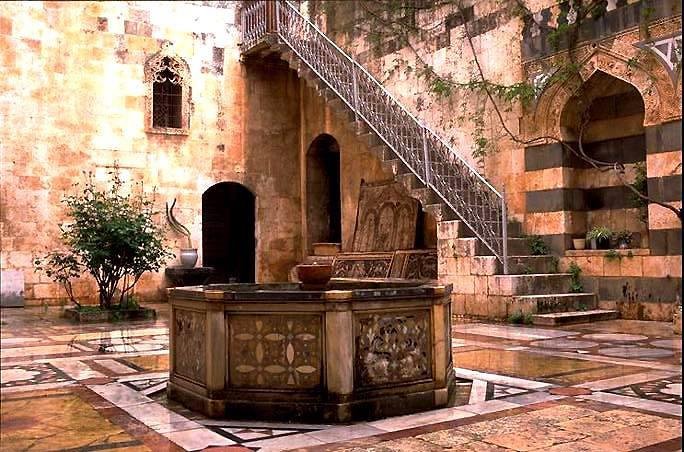
This is an example of traditional Arabic housing. This house is in Hama.
As these are some of the oldest housing they lack planning and therefore suffer some problems such as condensation which is why they have been redone. It is illegal to knock them down and rebuild so only renovation is allowed. They are upon the most expensive housing in Arabia and as you can see they are usually a large open space in the middle with plants, fountains and a seating area, and rooms all around.
As these are some of the oldest housing they lack planning and therefore suffer some problems such as condensation which is why they have been redone. It is illegal to knock them down and rebuild so only renovation is allowed. They are upon the most expensive housing in Arabia and as you can see they are usually a large open space in the middle with plants, fountains and a seating area, and rooms all around.
.1.jpg)
Traditional Arabian Housing (example in Damascus)
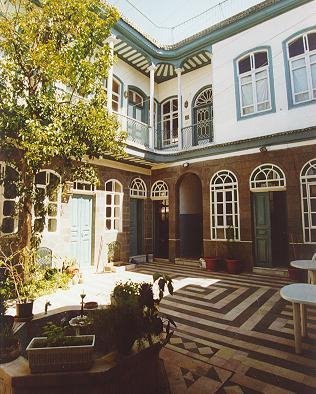
This is an example of traditional Arabic housing. This house is in Damascus and has been redone.
As these are some of the oldest housing they lack planning and therefore suffer some problems such as condensation which is why they have been redone. It is illegal to knock them down and rebuild so only renovation is allowed. They are upon the most expensive housing in Arabia and as you can see they are usually a large open space in the middle with plants, fountains and a seating area, and rooms all around. Upstairs there are balconies as you can see.
As these are some of the oldest housing they lack planning and therefore suffer some problems such as condensation which is why they have been redone. It is illegal to knock them down and rebuild so only renovation is allowed. They are upon the most expensive housing in Arabia and as you can see they are usually a large open space in the middle with plants, fountains and a seating area, and rooms all around. Upstairs there are balconies as you can see.
Sunday, April 16, 2006
.1.jpg)
Saturday, April 15, 2006
Teshreen Road (Aleppo - حلب)
Teshreen Road is linked to Nile Road making it very accessible. The housing is of the most common in Aleppo and for being in the Centre of the city it is surprisingly quiet.
.jpg)
Subscribe to:
Posts (Atom)
 DreamHost promos